

Wineries and wine
More present in the southern area of Palencia, the wineries are part of the history and tradition of a province that has always been linked to wine and wine culture. There are commercial wineries of the highest quality and private wineries that hide the essence of artisanal production of grape derivatives. A unique product.
The province of Palencia, in Castilla y León, stands out for its rich winemaking tradition and the presence of two denominations of origin: Arlanza and Cigales. These denominations cover various localities that house wineries with a centuries-old history and high-quality wine production.
Wineries in the Arlanza Denomination of Origin:
Bodegas Valdesneros: Located in the Ribera del Arlanza, this winery is committed to the artisanal production of wines with a unique personality, taking advantage of the region's thermal amplitude to obtain wines with great body and structure.
Bodega Carreprado: Located in Alba de Cerrato, this family winery merges tradition and innovation to create wines of excellent quality, reflecting the essence of the land in every bottle.
Wineries in the Cigales Denomination of Origin:
Bodega Remigio Salas: Located in Dueñas, this historic winery is the only one in the D.O. Cigales in the province of Palencia. It offers a unique wine tourism experience, allowing visitors to immerse themselves in the winemaking tradition of the region.
Underground Wineries:
Baltanás: This municipality is home to the largest set of underground wineries in Spain, with nearly 400 wineries excavated in the Castillo hill. These wineries, dating back to the 15th century, have been classified as a Site of Cultural Interest.
Torquemada: It preserves an important set of traditional wineries, witnesses to the historical importance of viticulture in the region.
Wine Routes:
Arlanza Wine Route: This route allows you to explore the winemaking tradition of the region, visiting wineries and enjoying unique landscapes.
Cigales Wine Route: Offers an immersion in the history and culture of the region's wine, combining visits to wineries with tastings and cultural activities.
Wine tourism in Palencia has established itself as an enriching experience, combining winemaking tradition with the cultural and natural heritage of the province.

Wineries in Torquemada
The wineries in Torquemada are located in a town in Palencia known for preserving a set of traditional wineries of great interest, a testament to the importance that vineyards and the aging of some wines had in the region since the 16th century. The wineries of Torquemada are unique in that they have their own configuration; without any hills, they are developed on flat land to the west of the village to achieve optimal humidity and temperature for wine production. These wineries feature a significant slope as their most characteristic aspect. Torquemada has five neighborhoods of varying sizes: Valdesalce wineries, Ladrero wineries, Barrionuevo wineries, Paramillo wineries, and Carrovillamediana wineries. Torquemada, in the province of Palencia, is known for its unique set of underground wineries, which have been declared a Site of Cultural Interest. These wineries are excavated in alluvial soils. Their arrangement in straight and almost parallel streets, oriented from east to west, creates a unique urban landscape.
Currently, Torquemada hosts two operational wineries that produce wines under the Arlanza Denomination of Origin:
Bodegas Valdesneros: Founded in 1997, this winery is committed to the artisanal production of quality wines. It offers guided tours that include an explanation of the winemaking process, a tasting of three wines, and a snack.
Bodega Esteban-Araujo: This underground winery offers tours and tasting sessions, allowing visitors to closely experience the wine production process in a traditional setting.
In addition to these wineries, the town features the Barrio de Bodegas, an ethnological complex that allows visitors to delve into the history and wine tradition of the region. This neighborhood stands out for its underground architecture and urban layout, offering a unique experience for wine and culture enthusiasts.
For those who wish to delve deeper into the history and culture of wine in Torquemada, a visit to the Museo Fundación Rodríguez Bustos is recommended. It offers a detailed view of the area's wine tradition and a journey back in time to see what a house, utensils, and vehicles were like in the 1960s.
In summary, Torquemada offers a rich wine tourism experience, combining visits to operational wineries with the exploration of its underground wine heritage.
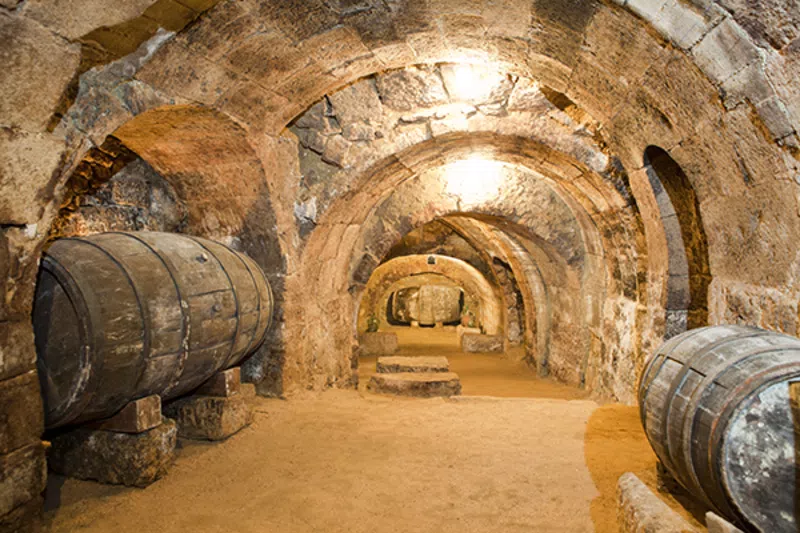
Wineries in Astudillo. An underground world.
Astudillo hides beneath its surface a fascinating labyrinth of underground corridors, consisting of almost 90 sections that total nearly two kilometers in length. These are cellars dug into the clay surrounding the town, especially in the areas of La Mota and El Altillo. Although many of these cellars are underground, some were built with limestone ashlar or masonry. The urban area concentrates a large number of them, creating what could be described as "another Astudillo beneath Astudillo." These underground cellars, whose construction possibly dates back to the Middle Ages, reflect the rich winemaking tradition of the area. Until the mid-20th century, vineyard cultivation was a predominant activity in the region. Although this practice has declined, small vineyards still remain around the village, and numerous cellars, many of which have been transformed into picnic areas. The galleries are notable for their earthen floors and their semicircular or pointed vaults. Their original function is uncertain, but it is speculated that they may have had a military use before being compartmentalized and repurposed as cellars after the abandonment of the La Mota castle. Exploring the cellars of Astudillo allows one to discover a unique part of its history and culture, appreciating the ingenious architecture and construction techniques employed in these unique underground structures.

Wineries in Venta de Baños
In the town connected to the railway and close to Palencia, we find the Barrialba wineries, which produce exquisite wines. Their harvesting process is done manually, which is why they treat their raw materials with great care. Their goal is to combine modern processes with tradition to obtain the best wines. These are artisanal wines made from vines near the lands of Ribera de Duero. For some, it is surprising to find wineries in Venta de Baños, but the truth is that this town has always maintained this winemaking tradition.
Bodegas Barrialba is a winery located in Venta de Baños, about 10 kilometers from Palencia and 37 kilometers from Valladolid. The winery specializes in producing high-quality red wines under the IGP Vino de la Tierra de Castilla y León designation. Their wines are made from Tempranillo grapes, sourced from vineyards with an average age of 40 years, ensuring a rich and mature flavor profile. The winemaking process at Bodegas Barrialba is based on careful manual harvesting, followed by fermentation in stainless steel tanks at controlled temperatures. The wines undergo aging in oak barrels, composed of 60% American oak and 40% French oak, for periods ranging from 10 to 15 months. This meticulous aging process adds complexity and depth to their wines. If you are in Palencia and looking to explore local wineries, Bodegas Barrialba offers a combination of traditional winemaking techniques and modern facilities, reflecting their commitment to quality and respect for the land.
Bodegas Barrialba is a winery located in Venta de Baños, about 10 kilometers from Palencia and 37 kilometers from Valladolid. The winery specializes in producing high-quality red wines under the IGP Vino de la Tierra de Castilla y León designation. Their wines are made from Tempranillo grapes, sourced from vineyards with an average age of 40 years, ensuring a rich and mature flavor profile. The winemaking process at Bodegas Barrialba is based on careful manual harvesting, followed by fermentation in stainless steel tanks at controlled temperatures. The wines undergo aging in oak barrels, composed of 60% American oak and 40% French oak, for periods ranging from 10 to 15 months. This meticulous aging process adds complexity and depth to their wines. If you are in Palencia and looking to explore local wineries, Bodegas Barrialba offers a combination of traditional winemaking techniques and modern facilities, reflecting their commitment to quality and respect for the land.

Wineries in Palenzuela
On the border with the province of Burgos, in the DO Ribera del Arlanza, we find this small town. It is an area with a winemaking tradition and everything related to this world. A reason to gather around a table and enjoy wines crafted in a traditional space like a winery. In Palenzuela, the Pagos de Negredo wineries are located, with vineyards that boast over 100 years of history.

Wineries in Dueñas
In Dueñas, we can find numerous privately-owned wineries. These are small caves located on the highest hills of the Palencia area, which in the past were also used as dwellings. The wineries maintain a constant temperature of (13ºC – 15ºC). Currently, only one winery remains dedicated to the production and commercialization of wine, the Bodegas Remigio Salás Jalón, which belongs to the DO Cigales. We recommend visiting if you wish to see one of the last traditional wineries, but with a modernized section to meet the growing global demand for this fantastic wine.

Wineries in Frómista
Bodegas Zarzavilla is one of the oldest wineries in the region, dating back to the 15th century. Its production began with Benedictine monks and, after the Mendizábal disentailment, it was acquired by Alejo Serrano Peña in 1850. His grandson, Carmelo Serrano Peña, continues the legacy in modern facilities, producing wines under the DO Tierra de Castilla y León. Carmelo, a businessman from Palencia, inherited his passion for wine from his grandfather Alejo, who emigrated to Frómista and acquired a 15th-century underground winery, noted for its Gothic arches and spacious halls. Today, Carmelo has restored the winepress for visits and tastings, promoting the family winemaking tradition with Zarzavilla wine, aged in oak, with a deep red color, aromas of ripe fruits, and sweet tannins. Made from the first pressing of the Ribera del Duero, due to the scarce grape production in Frómista, the wine ages in 50% French and American oak barrels, in the ideal environment of the underground winery.

Wineries in Baltanás
Cultural Heritage Site (BIC): Baltanás Wineries
Baltanás boasts approximately 400 wineries located in the well-known "El Castillo" neighborhood. This municipality is part of the Arlanza Denomination of Origin. Today, the wineries are the perfect place to enjoy with family or friends, where you can taste fresh wines and local cheeses, still produced in the area. Therefore, we recommend a visit. The Museum of Cerrato Castellano offers an excellent display of how the wineries were and are in this charming town. Baltanás, situated in the Cerrato Palentino region, hosts a unique collection of 374 underground wineries distributed across six levels, excavated into a hill known as the Cerro del Castillo. These wineries, dating back to the 16th century, were declared a Cultural Heritage Site in 2015. The winery district of Baltanás is an exceptional example of traditional underground architecture, where wine was historically produced and preserved under optimal temperature and humidity conditions. Today, many of these wineries are still in use, serving as meeting and tradition spaces for the locals. For those who wish to learn more about this heritage, La Zarcera offers guided tours of the winery district, allowing visitors to immerse themselves in the wine history and culture of the region.
Baltanás boasts approximately 400 wineries located in the well-known "El Castillo" neighborhood. This municipality is part of the Arlanza Denomination of Origin. Today, the wineries are the perfect place to enjoy with family or friends, where you can taste fresh wines and local cheeses, still produced in the area. Therefore, we recommend a visit. The Museum of Cerrato Castellano offers an excellent display of how the wineries were and are in this charming town. Baltanás, situated in the Cerrato Palentino region, hosts a unique collection of 374 underground wineries distributed across six levels, excavated into a hill known as the Cerro del Castillo. These wineries, dating back to the 16th century, were declared a Cultural Heritage Site in 2015. The winery district of Baltanás is an exceptional example of traditional underground architecture, where wine was historically produced and preserved under optimal temperature and humidity conditions. Today, many of these wineries are still in use, serving as meeting and tradition spaces for the locals. For those who wish to learn more about this heritage, La Zarcera offers guided tours of the winery district, allowing visitors to immerse themselves in the wine history and culture of the region.

Wineries in Tariego de Cerrato
In Tariego de Cerrato, traditional wineries are primarily located underground, as is common in the Cerrato Palentino region. These wineries, carved into the Castle Hill, have historically been used for the production and preservation of wine. Although many of them are privately owned, some have been adapted into restaurants that offer a unique dining experience in an underground setting. Below are some of the notable establishments in Tariego de Cerrato:
These wineries and restaurants not only provide a quality culinary experience but also allow visitors to immerse themselves in the wine-making history and tradition of the region. If you are interested in learning more about the wine history and culture of Tariego de Cerrato, we recommend visiting these establishments and exploring the underground wineries that have witnessed centuries of tradition.
These wineries and restaurants not only provide a quality culinary experience but also allow visitors to immerse themselves in the wine-making history and tradition of the region. If you are interested in learning more about the wine history and culture of Tariego de Cerrato, we recommend visiting these establishments and exploring the underground wineries that have witnessed centuries of tradition.

Wineries in Autilla del Pino
Wineries in Autilla del Pino, very close to the capital.
Autilla del Pino is located 8 km from the capital of Palencia. It is well-known for hosting the famous "Mirador de Campos," a viewpoint from which you can see at least 20 localities, and on very clear days, you can also spot the mountains 100 km away. Right below the viewpoint, you will find the wineries, most of which are private. Some are open to the public and are famous for their homemade and Castilian cuisine. Autilla del Pino, in the Cerrato Palentino region, is known for its traditional underground wineries, carved into the hill of the Castle. These wineries, dating back to the 16th century, were declared a Site of Cultural Interest in 2015. These wineries not only offer a quality culinary experience but also allow visitors to immerse themselves in the history and wine-making tradition of the region. If you are interested in learning more about the history and wine culture of Autilla del Pino, we recommend visiting these establishments and exploring the underground wineries that have witnessed centuries of tradition. Nowadays, some of these wineries have been adapted into restaurants that offer a unique gastronomic experience in an underground setting.
Autilla del Pino is located 8 km from the capital of Palencia. It is well-known for hosting the famous "Mirador de Campos," a viewpoint from which you can see at least 20 localities, and on very clear days, you can also spot the mountains 100 km away. Right below the viewpoint, you will find the wineries, most of which are private. Some are open to the public and are famous for their homemade and Castilian cuisine. Autilla del Pino, in the Cerrato Palentino region, is known for its traditional underground wineries, carved into the hill of the Castle. These wineries, dating back to the 16th century, were declared a Site of Cultural Interest in 2015. These wineries not only offer a quality culinary experience but also allow visitors to immerse themselves in the history and wine-making tradition of the region. If you are interested in learning more about the history and wine culture of Autilla del Pino, we recommend visiting these establishments and exploring the underground wineries that have witnessed centuries of tradition. Nowadays, some of these wineries have been adapted into restaurants that offer a unique gastronomic experience in an underground setting.